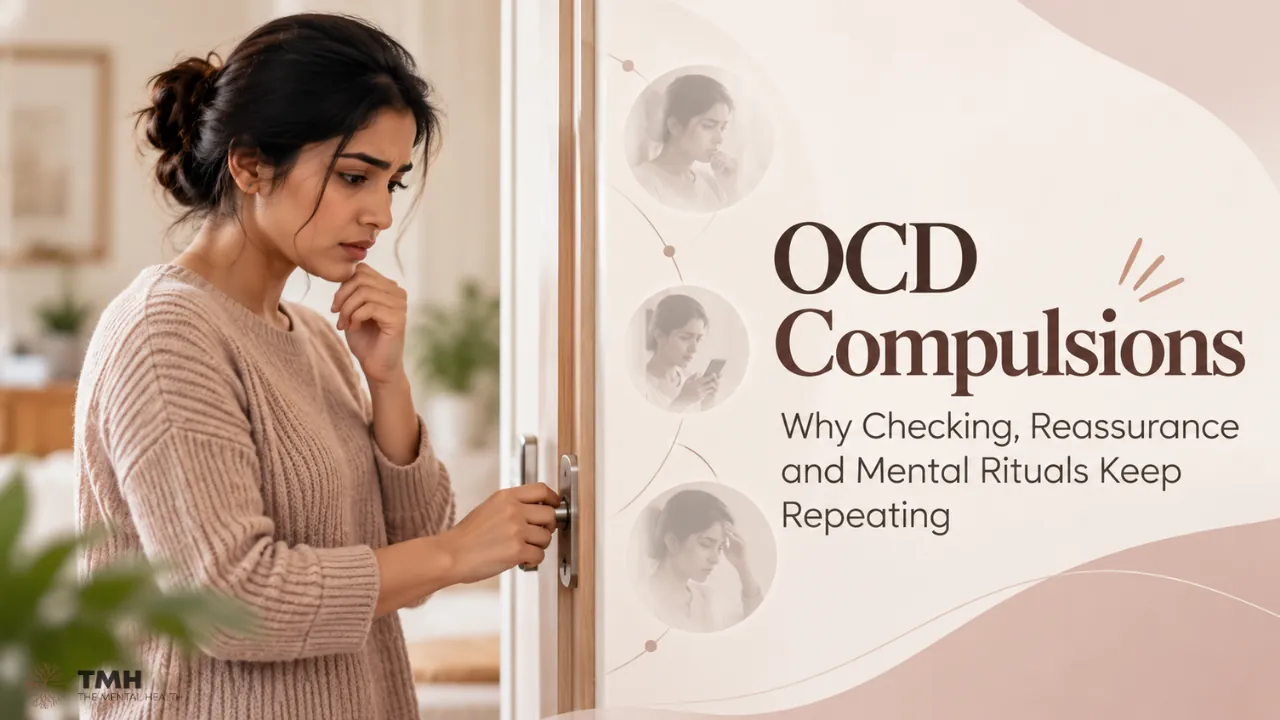
Obsessive-compulsive disorder (OCD) is a mental health condition in which unwanted, distressing thoughts lead to repeated actions or mental rituals that a person feels driven to perform. Many people with OCD live with it quietly for years, often because the thoughts feel too shameful or strange to say out loud. This article explains what intrusive thoughts are, how compulsions keep OCD going, how it is assessed, and what treatment can offer.
If you have been searching for answers late at night, wondering whether a thought means something terrible about you, you are far from alone. OCD is a recognised and treatable condition, and understanding how it works is often the first real relief.
If you are in danger right now
If you have hurt yourself, are thinking of ending your life, or feel you may act on thoughts of harming yourself or someone else, please do not wait for an appointment. Call 112, go to the nearest hospital emergency department, or call Tele-MANAS on 14416 or 1-800-891-4416. Tele-MANAS is the Government of India's free mental health helpline, open 24 hours, in many Indian languages. Messages to The Mental Health are answered during clinic hours.
What Is OCD?
Obsessive-compulsive disorder is a mental health condition defined by two linked parts: obsessions and compulsions. A person can have mostly one or mostly the other, but in most cases both are present and feed each other.
The word "obsessive" causes confusion. In everyday speech, people say they are "obsessed" with a cricket team or a new phone, meaning they enjoy it a lot. In OCD, an obsession is the opposite of enjoyable. It is a thought that arrives uninvited, feels wrong or frightening, and refuses to leave.
Both major diagnostic systems used by professionals, ICD-11 and DSM-5-TR, recognise OCD as its own condition within a group of "obsessive-compulsive and related disorders". It is closely connected to anxiety but is understood and treated in its own way.
What OCD is not
Liking a tidy desk, being organised or double-checking an important email does not mean someone has OCD. Saying "I'm so OCD" about neatness makes the real condition sound trivial, when for many people it takes up hours of the day and causes real suffering.
What separates OCD from ordinary habits is the distress involved, the time it consumes, and how much it gets in the way of work, study, relationships or rest.
What Are Intrusive Thoughts?
Intrusive thoughts are unwanted thoughts, images or urges that pop into the mind suddenly and feel upsetting or out of character. Almost everyone has them at some point. Research on people without OCD has found that most report occasional intrusive thoughts of the same kinds that people with OCD describe.
A few examples someone might experience:
A sudden image of pushing someone in front of a train while standing on a platform
A thought about shouting something offensive during a prayer or a quiet meeting
A flash of doubt like "What if I don't really love my partner?"
An unwanted sexual or violent image that feels disturbing and wrong
For most people, a thought like this passes. They may notice it, think "that was odd," and move on. In OCD, the thought sticks. The person treats it as dangerous or meaningful, feels intense anxiety, and starts trying to get rid of it, neutralise it or make sure it can never come true.
Do intrusive thoughts mean I want to act on them?
No. This is the single most important point in the whole article. Intrusive thoughts in OCD are usually ego-dystonic, a clinical term meaning they go against the person's values, wishes and sense of who they are. That is exactly why they cause so much distress.
A loving parent with harm-related OCD may be horrified by an image of hurting their baby. The horror is the clue. People with OCD tend to avoid situations linked to their fears and put enormous effort into preventing harm, which is very different from wanting it.
If you are unsure whether your thoughts fit this pattern, a qualified mental health professional can help you understand them without judgement.
What Are the Symptoms of OCD?
OCD symptoms fall into two groups, obsessions and compulsions. They vary a lot from person to person and can change over time.
Common obsessions
Obsessions often cluster around certain themes. Some of the more common ones are:
Contamination: fear of germs, dirt, bodily fluids, illness or "spreading" something to others
Harm: fear of causing harm by accident or on purpose, or of being responsible for something bad happening
Doubt and checking: uncertainty about whether the door is locked, the gas is off or a task was done correctly
Symmetry and "just right" feelings: a need for things to be even, ordered or complete
Unwanted sexual thoughts: distressing thoughts or images that go against the person's values or orientation
Religious or moral fears: sometimes called scrupulosity, involving fear of sinning, blasphemy or being a bad person
Relationship doubts: repeated questioning of whether a relationship is "right," sometimes called relationship OCD
Common compulsions
Compulsions are things a person feels driven to do to reduce anxiety or prevent a feared outcome. Visible compulsions include:
Washing or cleaning repeatedly, often following strict rules
Checking locks, switches, appliances or messages many times
Arranging or repeating actions until they feel "just right"
Counting, tapping or touching in a particular pattern
Asking others for reassurance again and again
Mental compulsions
Many compulsions happen silently inside the mind, so others may never see them. These can include mentally reviewing past events, replacing a "bad" thought with a "good" one, praying or repeating phrases in a fixed way, or analysing a thought until it feels settled.
This is why some people believe they have "Pure O," a term for OCD that seems to involve only obsessions. In most such cases, compulsions are present but take a mental form. Recognising them matters, because treatment works on the hidden rituals as well as the visible ones.
Avoidance
People with OCD often avoid places, objects or people that trigger their fears. Someone with contamination fears may stop using public washrooms. Someone with harm-related thoughts may stop holding knives or being alone with a child. Avoidance brings short-term relief but slowly shrinks a person's life.
How the OCD Cycle Works
OCD is kept going by a loop that repeats itself. Understanding this loop is central to understanding treatment.
Trigger: something sets off an intrusive thought, such as touching a door handle.
Obsession: the thought appears ("I might have picked up germs and will make my family ill").
Anxiety: the thought brings fear, disgust, guilt or a strong sense that something is wrong.
Compulsion: the person does something to reduce the feeling, such as washing their hands in a particular way.
Short-term relief: the anxiety drops for a while.
The trouble is in step five. Because the compulsion brings relief, the brain learns that the thought really was dangerous and that the ritual is necessary. The next time the thought appears, the urge to perform the compulsion is stronger. Over time, the cycle tightens.
Why reassurance doesn't last
Reassurance works the same way. Asking "Are you sure I locked the door?" or searching online to confirm a thought means nothing can calm the anxiety briefly. Then doubt returns, often within minutes, and more reassurance is needed. Family members usually reassure out of love, which is completely understandable, but it can keep the cycle running.
What Does OCD Feel Like From the Inside?
People describe OCD in very different ways. Some say it feels like a constant alarm that won't switch off. Others describe a nagging sense of incompleteness, as though a task is never quite finished.
Many people know their fears are unlikely or even irrational, yet still feel unable to resist the urge to act. Others are less sure and feel that their fears could be real. Professionals call this the level of insight, and it can vary from person to person and even from day to day.
Shame is common. People with distressing sexual, violent or religious thoughts often keep them secret for years, fearing they will be judged or seen as dangerous. A trained clinician has heard thoughts like these many times and understands them as symptoms, not confessions.
OCD can also be exhausting. Time spent on rituals, checking and mental reviewing can leave little energy for anything else, and some people develop low mood or depression as a result.
What Causes OCD?
There is no single cause of OCD. Research suggests it develops from a combination of factors, and these differ between individuals.
Biological factors. OCD tends to run in families, which suggests genes play a part. Brain imaging studies have found differences in certain brain circuits involved in detecting threats and stopping repeated behaviours.
Psychological factors. Certain beliefs are common in OCD, such as an inflated sense of responsibility, the idea that having a thought makes it more likely to happen, or a strong need for certainty. These beliefs make ordinary intrusive thoughts feel urgent.
Life events. Stress, major life changes or difficult experiences do not cause OCD on their own, but they can trigger its onset or make symptoms worse. Some people first notice symptoms during pregnancy or after the birth of a child.
OCD often begins in childhood, adolescence or early adulthood, although it can start at any age. It is not caused by weak character, poor upbringing or lack of willpower.
Can a medical problem cause OCD-like symptoms?
Occasionally, physical health problems or certain substances can produce symptoms that look like OCD or anxiety. In children, a sudden and dramatic onset of symptoms sometimes needs medical evaluation. A psychologist may suggest a check-up with a doctor where this seems relevant.
OCD vs Overthinking, Anxiety and Perfectionism
Several conditions and traits overlap with OCD, which is why careful assessment matters.
OCD vs overthinking
Overthinking usually involves going over real-life worries, such as money, work or a difficult conversation. OCD obsessions often feel strange, unwanted or unrelated to actual risk, and they come with compulsions designed to cancel the thought out.
OCD vs generalised anxiety
In generalised anxiety, worries tend to be about everyday matters and shift from topic to topic. In OCD, the fears tend to be more specific and are usually tied to rituals or mental neutralising.
OCD vs perfectionism
Perfectionism is a personality trait linked to high standards. OCD rituals are driven by anxiety or a need to prevent something bad, and they feel compelled rather than chosen. Some people have both.
Related conditions
Conditions such as body dysmorphic disorder, hoarding disorder and hair-pulling (trichotillomania) sit in the same group of related disorders. OCD also commonly occurs alongside depression, anxiety disorders and ADHD. A full assessment looks at the whole picture.
How Is OCD Diagnosed?
OCD is diagnosed by a qualified mental health professional such as a clinical psychologist or psychiatrist, usually through a detailed conversation rather than a single test.
During an assessment, the clinician may ask about:
The kinds of thoughts you have and how you respond to them
How much time obsessions and compulsions take up each day
How much distress they cause
How they affect work, study, relationships and daily routine
When they started and whether anything makes them better or worse
Other concerns such as mood, sleep or substance use
Clinicians sometimes use structured rating scales, such as the Yale-Brown Obsessive Compulsive Scale (Y-BOCS), to measure severity and track progress over time. These are tools used by trained professionals and are not a do-it-yourself diagnosis.
Online quizzes may help someone recognise a pattern, but they cannot diagnose OCD. Many experiences that look similar on a checklist have very different explanations.
How Is OCD Treated?
OCD is treatable, and many people experience a significant reduction in symptoms with the right support. Treatment is usually tailored to the person, depending on the severity of symptoms, their age, any other conditions and their own preferences.
The main evidence-based options are psychotherapy, medication, or a combination of both.
Cognitive behavioural therapy (CBT) for OCD
Cognitive behavioural therapy is a structured talking therapy that helps people notice and change unhelpful patterns of thinking and behaviour. For OCD, the most researched form of CBT includes a technique called exposure and response prevention. Clinical guidelines such as those from NICE in the UK recommend CBT with ERP as a first treatment option for OCD.
What is exposure and response prevention (ERP)?
Exposure and response prevention involves gradually and deliberately facing the thoughts, situations or objects that trigger obsessions (exposure), while choosing not to carry out the usual compulsion (response prevention).
For example, someone with contamination fears might begin by touching a slightly "dirty" object and waiting before washing. Over time, with the therapist's guidance, they move towards harder situations. Someone with mental rituals might practise letting an intrusive thought stay in the mind without reviewing or neutralising it.
The aim is not to prove the fear wrong through argument. It is to let the brain learn, through experience, that anxiety can rise and fall on its own and that the feared outcome does not depend on the ritual.
ERP is done step by step, at a pace agreed between the client and the therapist. Nobody is forced into situations they are not ready for. Most of the practice happens between sessions, in daily life, which is where change tends to stick.
Cognitive therapy approaches
Alongside ERP, therapists often help clients look at the beliefs that give intrusive thoughts their power. These may include the belief that having a thought is the same as acting on it, or that one is fully responsible for preventing every possible harm. Approaches such as REBT and acceptance-based therapy can also help people relate differently to unwanted thoughts.
How long does OCD treatment take?
This varies a great deal. Some people notice change within a few months of regular sessions, while others need longer, especially if symptoms are severe or have been present for many years. Progress is rarely a straight line, and setbacks during stressful periods are common and manageable.
Can OCD be treated without medication?
For many people with mild to moderate OCD, CBT with ERP on its own can be an effective treatment. For moderate to severe OCD, or when OCD occurs with significant depression, guidelines often suggest that medication alongside therapy may help.
Medication for OCD is prescribed and monitored by a psychiatrist or medical doctor. Psychologists do not prescribe medication. Any questions about starting, changing or stopping medication should always be discussed with the prescribing doctor. Many people find that therapy and medication together work better than either alone.
Is OCD curable?
OCD is usually described as a condition that can be treated and managed rather than "cured." With effective treatment, many people find their symptoms reduce substantially, sometimes to the point where OCD no longer controls their daily life. Learning to respond to intrusive thoughts differently is a skill that tends to last, and it helps people handle any future flare-ups.
What Happens in OCD Therapy With a Psychologist?
The first few sessions usually focus on understanding your experience. The psychologist asks about your thoughts, rituals, triggers and daily life, and explains how the OCD cycle applies to you.
Together, you build a list of situations that trigger anxiety, ranked from easier to harder. This becomes the map for exposure work. Sessions also involve learning to spot hidden compulsions, including reassurance-seeking and mental reviewing.
Between sessions, you practise what was planned. This might feel uncomfortable at first, and that discomfort is part of how the treatment works. A good therapist will check in regularly, adjust the pace and help you understand what is happening.
Where family members are closely involved in rituals or reassurance, the psychologist may invite them to a session. For children and teenagers, parents are usually part of treatment.
Self-Help That Supports Professional Care
Self-help can complement therapy but is not a replacement for it, especially if OCD is affecting daily life. Some things that many people find useful:
Learning about OCD. Understanding the cycle reduces fear and shame.
Labelling the thought. Noticing "this is an OCD thought" can create a little distance.
Delaying a ritual. Waiting a few minutes before acting on an urge can show that anxiety can ease without the ritual.
Cutting back on reassurance. This is easier with a therapist's guidance, as it can feel very uncomfortable at first.
Looking after the basics. Sleep, regular meals, movement and time with people you trust all help with stress, which tends to worsen OCD.
Arguing with intrusive thoughts or trying to push them away usually makes them return more often. That is one reason guided treatment tends to work better than going it alone.
How Family Members Can Help
Living with someone who has OCD can be confusing and tiring. Families often get drawn into rituals without meaning to, by answering the same question repeatedly, washing things a certain way or avoiding certain topics. Professionals call this family accommodation.
Accommodation comes from care, and nobody should feel blamed for it. Still, it can keep OCD going. A psychologist can help families reduce accommodation gradually and kindly, so the person with OCD feels supported rather than rejected.
Some helpful approaches:
Learn how OCD works so you can see the symptom, not a stubborn person
Respond with warmth while gently avoiding repeated reassurance
Notice and acknowledge effort, even small steps
Avoid jokes about rituals or thoughts
Look after your own wellbeing too
OCD in Children and Teenagers
OCD can begin in childhood. Children may not have the words to explain their thoughts, so parents might notice behaviours instead: long bedtime routines, repeated questions, excessive handwashing, distress when things are not "right," or avoiding school because of fears.
Many young children go through phases of rituals, such as wanting things done in a certain order, which are a normal part of development. It becomes a concern when rituals cause distress, take up a lot of time or interfere with school, friendships or family life.
Child and adolescent therapy for OCD usually involves CBT adapted to the child's age, with active involvement from parents. A professional assessment is important before drawing any conclusions.
When to Seek Help
It may be time to speak with a mental health professional if:
Unwanted thoughts or rituals take up more than an hour or so of your day
You are avoiding places, people or tasks because of your fears
You need reassurance repeatedly and it never seems enough
OCD is affecting work, study, sleep or relationships
You feel ashamed, exhausted or low because of your thoughts
A child or teenager shows rituals or fears that are causing them distress
You don't need to be sure it is OCD before asking for help. A clinical psychologist can help you understand what is going on and what kind of support fits.
When to seek urgent help
Seek urgent help if you or someone you know:
Is talking about wanting to die or having no reason to live
Is making plans to end their life
Feels unable to keep themselves safe
Appears to be losing touch with reality
OCD and depression often occur together, and long-term distress can lead to hopeless thoughts. These thoughts can be treated, and support is available right now.
Questions to Ask a Therapist About OCD Treatment
If you are considering therapy, these questions can help you choose:
Do you have experience treating OCD specifically?
Do you use CBT with exposure and response prevention?
How will we decide the pace of exposure work?
How will family members be involved, if at all?
How will we know if treatment is helping?
When would you suggest a psychiatric consultation?
Key Takeaways
OCD involves obsessions (unwanted intrusive thoughts) and compulsions (actions or mental rituals done to reduce anxiety).
Intrusive thoughts are common and do not reflect a person's true wishes or character.
Compulsions, avoidance and reassurance bring short-term relief but keep the OCD cycle going.
CBT with exposure and response prevention is a well-researched treatment, sometimes combined with medication from a psychiatrist.
OCD is treatable, and many people see their symptoms reduce significantly with the right support.
Final Thoughts
OCD can make a person doubt their own mind, which is one of the hardest things a human being can go through. Yet the thoughts that feel most frightening are often the ones that least reflect who someone really is. Once people understand how the OCD cycle works, the condition starts to lose some of its hold.
Treatment asks for courage, patience and practice, and it rarely feels comfortable at the start. Many people who once spent hours a day caught in rituals go on to live full lives, with OCD as a much quieter presence.
If this sounds familiar, talking to a qualified mental health professional can help you make sense of what you are experiencing. If you are in Borivali or elsewhere in Mumbai and would like to speak with a clinical psychologist, you can book an in-person or online session with Dr. Mithila Desai at The Mental Health.
Guides in this series
Each of these shorter guides looks at one part of this topic in more detail:
- Intrusive Thoughts vs OCD: When Thoughts Become a Cycle
- OCD Compulsions: Why Checking and Rituals Keep Repeating
- OCD vs Overthinking: How to Tell the Difference
- Can OCD Be Treated Without Medication?
- OCD in Children and Teens: Signs Parents Should Notice
Common questions
Are intrusive thoughts a sign of OCD?
Not on their own. Most people have occasional intrusive thoughts that feel strange or upsetting, and these usually pass without much attention. They become part of OCD when they cause intense distress, keep returning, and lead to compulsions such as checking, reassurance-seeking or mental rituals that take up time and affect daily life. A qualified professional can help you understand which pattern fits your experience.
Can intrusive thoughts make me act on them?
People with OCD are generally no more likely to act on their intrusive thoughts than anyone else. These thoughts tend to go against a person's values, which is why they cause so much fear and guilt. The distress itself is a sign that the thought is unwanted. If you are worried about your thoughts, a clinical psychologist can talk them through with you in a safe, non-judgemental way.
What is "Pure O" OCD?
"Pure O" is an informal term for OCD that appears to involve only obsessions without visible compulsions. In most cases, compulsions are still present but happen inside the mind, such as reviewing memories, mentally checking feelings, praying in a fixed way or replacing thoughts. Identifying these hidden rituals is important, because effective treatment such as CBT with ERP works on mental compulsions as well as visible ones.
How long does it take for ERP therapy to work?
The timeline varies from person to person. Some people notice meaningful change within a few months of regular sessions and consistent practice, while others need longer, particularly if OCD is severe, long-standing or occurs with other conditions. Progress depends on practice between sessions as well as the sessions themselves. Your therapist will review progress with you and adjust the plan as needed.
Is OCD a type of anxiety disorder?
OCD is closely linked to anxiety, and anxiety is a major part of how it feels. However, current diagnostic systems such as ICD-11 and DSM-5-TR place OCD in its own group called obsessive-compulsive and related disorders. This reflects differences in how OCD works and how it is treated, especially the central role of compulsions and the use of exposure and response prevention.
Should I stop reassuring a family member with OCD?
Reassurance comes from love, but repeated reassurance can keep OCD going by giving only short-lived relief. Stopping suddenly, however, can feel harsh and increase distress. It is usually better to reduce reassurance gradually and kindly, ideally with guidance from a psychologist who can involve the family in a plan that supports the person while weakening the OCD cycle.
Can children have OCD?
Yes. OCD can begin in childhood or adolescence. Signs may include long routines, repeated questions, excessive washing, distress when things are not "just right" or avoiding school because of fears. Some rituals are a normal part of child development, so a professional assessment is important. Treatment usually involves age-appropriate CBT with active parent involvement.
Do I need a psychologist or a psychiatrist for OCD?
Both can help, in different ways. A clinical psychologist provides assessment and psychotherapy such as CBT with ERP. A psychiatrist is a medical doctor who can assess OCD and prescribe and monitor medication when needed. Many people see a psychologist first, and a psychiatric consultation may be suggested if symptoms are severe or occur with conditions such as significant depression.

Registered with the Rehabilitation Council of India · Last reviewed 23 Nov 2026
This guide gives general information about psychological care at The Mental Health. It is not a diagnosis and does not replace a session. Read our editorial policy.